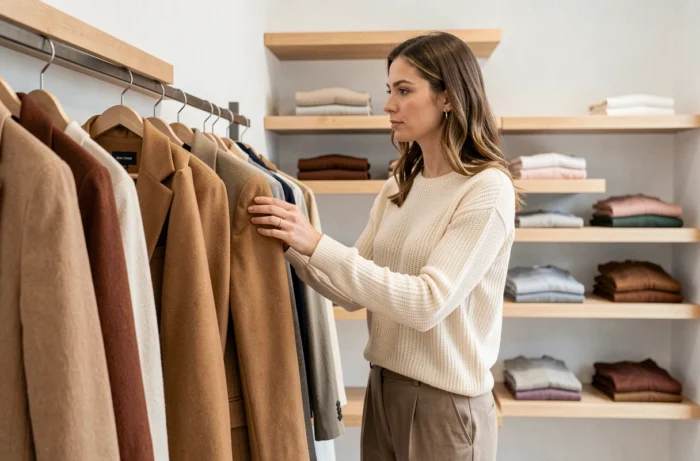
A thick knit sweater spotted in a store, a flowy pair of pants added to the online cart at midnight, a vintage jacket found on a second-hand app: we renew our wardrobe in fragments, often without a plan. The result is a closet filled with pieces that don’t work together. This season, fashion trends offer concrete ways to buy less and assemble better.
Second-hand and fashion e-commerce: two channels changing the shopping method
Before discussing colors or cuts, we need to talk about the playground. Shopping habits in France have shifted. Second-hand and ultra-fast fashion account for about a quarter of clothing purchases by volume, according to data from the Institut Français de la Mode reported by the Gazette des Commerçants in August 2026. Sales of new clothing have slightly declined since 2025.
At the same time, nearly a third of clothing purchases by value are now made online. Specifically, when searching for a beige trench coat or a pair of raw jeans, you have as much chance of finding it on a second-hand marketplace as in a shopping mall. You can follow shopping trends on My Fashion Mag to spot pieces worth investing in before making a purchase, regardless of the channel.
This dual movement is changing the strategy. Smart buying is no longer about waiting for sales: it’s about crossing channels, checking the availability of a piece second-hand before buying it new, and focusing your budget on items that are not easily found second-hand (swimwear, underwear, technical shoes).
Trendy pieces for autumn 2026: what really works in daily life
The runways offer a lot. We don’t need to adopt everything. Three main trends emerge for this season, tested in the real dressing room.
Aubergine purple as an alternative to black
This deep shade is everywhere in the autumn 2026 collections. Its practical appeal: it replaces black in formal outfits without requiring more effort to match. An aubergine sweater with raw jeans or beige pants works immediately. Aubergine is worn as a dark basic, not as an accent color.
Feedback varies on this point depending on skin tones, but the shade remains more flattering than burgundy for fair skin. In second-hand, pieces in these tones are already available because the color cycles back.
Relaxed tailoring instead of joggers
Fluid fabric pleated trousers, worn with sneakers or ankle boots, are gradually replacing joggers in everyday outfits. Tailored-style pants offer the same comfort with a more structured silhouette. Choose them in beige, gray, or chocolate to increase combinations.
Paired with a slightly oversized blazer, it creates a complete outfit for both the office and dinner. It’s the type of piece you keep for several seasons, which justifies spending a higher budget.
Mid-season layering
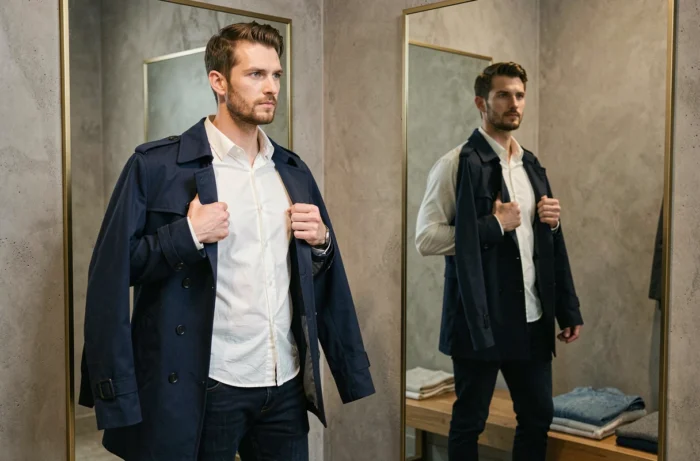
Trench coats, blazers, knit vests: mid-season calls for layers that can be taken off and put back on throughout the day. The 2026 trend leans towards visible layering (a shirt collar peeking out from a sweater, an open trench over a vest). It’s not just aesthetic: it’s a response to temperature fluctuations between morning and afternoon.
Renewing your wardrobe without buying everything new: the concrete method
You don’t need twenty new pieces. The capsule wardrobe logic, popularized in recent years, remains the most effective when simplified.
- Take inventory of what you’ve actually worn in the last three months. Clothes that have remained on hangers don’t count: they are candidates for resale or donation.
- Identify functional gaps: is there a need for a mid-season jacket, a dressy bottom, a versatile pair of shoes? Buy only what fills a gap, not what looks good in the window.
- Set a budget per piece rather than a total budget. Spending more on well-cut pants and less on a basic t-shirt allows for a balance between quality and volume.
- Check for second-hand availability before any new purchase, especially for branded items whose quality lasts over time.
This approach avoids the classic trap of seasonal shopping: accumulating trendy pieces that don’t match anything you already own.
Environmental claims on clothing: what changes in September 2026
A rarely discussed point in shopping guides: the European directive Empowering Consumers comes into effect on September 27, 2026. It prohibits vague environmental claims on products, such as “eco-friendly,” “sustainable,” or “green,” unless backed by verifiable proof and a certified label.
For us as consumers, this means labels will become more reliable. Brands that displayed vague ecological arguments will either have to prove them or remove them. After September 27, a “sustainable” claim without official certification will be illegal in the European Union.
In practice, we can use this as a purchasing filter. If a brand continues to use vague terms after this date, it’s a warning sign. Conversely, certified labels (GOTS, OEKO-TEX, EU Ecolabel) gain credibility as they become the only authorized channel to communicate on the environmental impact of a garment.
- Check for the presence of a certified label rather than a marketing slogan on the tag.
- Favor brands that detail the composition and origin of materials on their website.
- Be wary of “eco capsule” collections launched by fast fashion brands without independent certification.
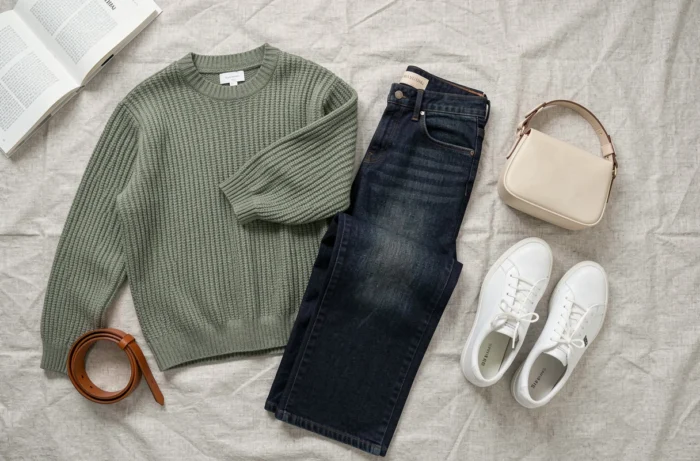
Renewing your wardrobe this season doesn’t necessarily require a big budget or a complete overhaul. The intersection of second-hand and targeted new purchases, combined with a few well-chosen pieces (fluid tailoring, aubergine shades, mid-season layers), creates a functional wardrobe without excess. The new regulations on environmental claims provide a concrete tool for sorting brands at the time of purchase.