
Black is not, strictly speaking, a color in the physical sense: it results from the absorption of the entire visible light spectrum. In fashion, this optical property makes it a shade that blurs surface contrasts and unifies silhouettes. The question of whether black is intrinsically feminine deserves to be asked based on concrete data rather than wardrobe habits.
Declared preference for black: a bias more masculine than feminine
The Korea Gallup survey on clothing colors, whose 2024 wave was analyzed by Hints42 and kdeepcut, delivers a result that challenges preconceived notions. Men heavily concentrate their preferences on a small number of neutrals (black, blue, gray, navy), while women’s choices are more dispersed and include a greater variety of chromatic shades.
In other words, black is statistically more favored among men than women in terms of declared preference. Qualifying black as a feminine color is therefore more a matter of Western cultural heritage than a measurable reality in contemporary purchasing behaviors.
This same series of surveys (waves 2004, 2014, 2019, 2024) shows another trend: beige and brown enter the top 10 favorite clothing colors for the first time in 2024, while pink and red decline significantly. The shift is more pronounced among women, suggesting a move towards warm neutrals rather than strict black.
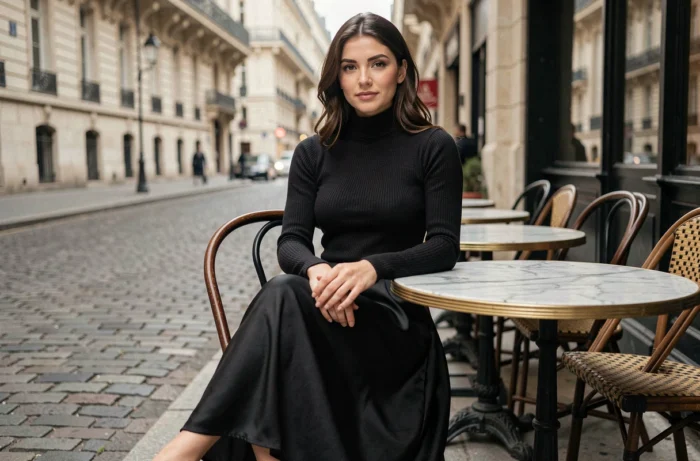
The little black dress and women’s wardrobe: a social code rather than a gendered color
The little black dress, popularized in the 1920s, is often cited as proof of the link between black and femininity. In reality, its success is due to a specific context: the simplification of women’s wardrobes after World War I, the reduction of Victorian mourning codes, and the search for functional elegance.
Before this period, black was primarily associated with magistrates, academics, and princes. It was a marker of social status and authority, not gender. The tuxedo, which appeared in the second half of the 19th century, anchored black in formal men’s attire long before women’s fashion adopted it on a large scale.
What black signals in current women’s fashion
Black in women’s wardrobes functions as a code of professional and creative recognition. In the fields of fashion, architecture, or design, wearing black signals cultural belonging. Practicality also plays a role: a black silhouette transitions from the office to dinner without a change of outfit.
This practical dimension explains the persistence of black, but it is not specifically feminine. The same arguments (versatility, discretion, ease of maintenance) apply to men. Black is not a feminine color; it is an urban and professional color, adopted by all genders for the same reasons.
Black and morphology: what color physics really says
The idea that black slims the silhouette is based on a real optical property: light absorption reduces the perception of volume and folds. However, this property does not work in isolation. The cut of the garment, the texture of the fabric, and the contrast with the skin significantly alter the visual result.
- A matte black fabric absorbs light evenly and effectively reduces the perception of volume, provided the cut follows the body’s lines without clinging.
- A shiny black fabric (satin, vinyl) reflects light in places and can accentuate curves instead of softening them.
- The contrast between a black garment and very light skin creates a sharp demarcation that draws attention to transitional areas (neck, wrists, ankles), which can produce the opposite effect of what is desired.
The slimming effect of black depends as much on the material and cut as on the color itself. Attributing this property to black without nuance simplifies a complex optical phenomenon.

Gender-neutral fashion and the decline of “feminine” black in recent collections
Recent collections show a trend towards gender fluidity in clothing proposals. Black remains present, but is rarely positioned as specifically feminine. Brands that adopt a gender-neutral approach use black as a neutral base, applicable to all bodies without distinction.
At the same time, the rise of beiges, browns, and earthy tones in women’s wardrobes redistributes the cards. Korea Gallup data indicate that women are diversifying their palettes more quickly than men, who remain focused on dark neutrals. Black remains a staple, but it is losing its status as the default choice in women’s wardrobes.
Black as a stylistic tool, not as a gender marker
Reducing black to a feminine color ignores several centuries of fashion history where it was first masculine, then institutional, and then universal. Black is a stylistic tool whose strength lies in its ability to function as a neutral background for textures, accessories, and cuts.
Black is the least gendered color in the clothing spectrum. The persistence of the myth of a “feminine” black is more due to the cultural weight of the little black dress than to a measurable reality in current preferences or purchasing behaviors.