
Printed materials remain a tangible visibility lever for businesses, even in a largely digitized environment. Behind the order of a brochure, a sign, or vehicle branding, there are regulatory, technical, and budgetary constraints that most service providers present very smoothly. Custom printing for businesses deserves closer examination, particularly regarding what has changed since 2023 in terms of outdoor advertising and responsible paper.
Outdoor Advertising Regulations: What Has Changed for Sign Printing
Any business that installs a panel, a lighted sign, or a façade signage device must now navigate a significantly modified local framework. Since January 1, 2024, the regulation of outdoor advertising falls under the mayor (or the president of the intercommunal structure in case of a transfer of competence). Authorizations, controls, and sanctions no longer follow the same channels as before.
For a large format printing project intended for outdoor use, this means that the administrative contact varies from one municipality to another. A custom printing provider that does not take this reality into account exposes its client to delays or installation refusals.
Another change: since January 1, 2025, the TLPE has been replaced by the Tax on Outdoor Advertising (TPE), which is optional and adjustable by local authorities. Businesses no longer need to make a systematic annual declaration but must report any creation or removal of signage within two months. Exemptions are possible depending on the municipalities. Before ordering a sign or window dressing, checking the local tax regime can prevent unexpected costs.
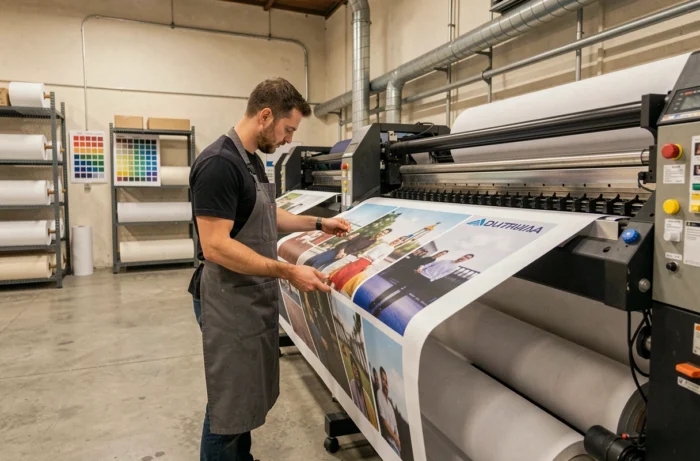
Professionals offering printing solutions for outdoor visual communication would benefit from integrating this regulatory support into their offerings. Field feedback varies on this point: some printers direct their clients to urban planning services, while others believe it is outside their scope. This service gap can weigh heavily on a signage project.
Printing Marketing Materials: The Responsible Paper Requirement Since 2023
Companies distributing promotional leaflets, brochures, or catalogs to consumers face a direct constraint. Since January 1, 2023, these materials must be printed on recycled paper or paper sourced from sustainably managed forests. This requirement applies to both large retail chains and local SMEs that publish their own catalogs.
The impact on the choice of provider is real. A printer that does not offer a certified range (sustainable forest management labels or traceable recycling channels) effectively places its client in violation. For companies outsourcing the production of their communication materials, the question of paper sourcing must be included in the specifications, just like weight or format.
This regulatory framework also guides budgetary decisions. Certified papers may represent a slightly higher unit cost, but the gap has narrowed in recent years with the increase in demand volume. Several platforms specializing in B2B printing, such as goall.fr, allow for comparison of available options and filtering offers based on the environmental certifications of the material.
Vehicle Branding and Mobile Visibility Materials: Often Underestimated Parameters
Vehicle branding is one of the custom printing segments where business expectations and technical realities diverge the most. A partial or full wrap of a utility vehicle seems simple at first glance: a graphic file, an adhesive film, installation in a workshop. In practice, several parameters condition the durability and compliance of the result.
- The quality of the adhesive film determines longevity. Cast films, which are more flexible and resistant to deformation, are better suited for the curved surfaces of vehicles than calendared films, which are cheaper but more rigid.
- Surface preparation (cleaning, degreasing) directly affects adhesion. A poorly prepared vehicle leads to premature peeling, often visible after just a few weeks.
- Local regulatory constraints on mobile advertising exist in certain protected areas or historic city centers. Overly visible branding may require prior declaration according to local advertising regulations.
For a company looking to increase its visibility on a controlled budget, vehicle branding offers one of the lowest costs per impression among all visual communication materials. Each trip generates visual contacts without recurring costs, provided that the quality of installation and materials is up to standard.

Custom Printing and Perceived Quality: What the Material Says About the Company
A brochure on thin paper, a business card with a curling lamination, a poster whose colors fade after a few days in a window: these details directly affect brand image. Companies often underestimate the impact of technical choices on customer perception.
Weight, type of finish (matte, glossy, soft-touch), and color fidelity are not cosmetic options. A poorly printed material degrades the commercial credibility of the company distributing it. Available data do not allow for precise quantification of this effect, but feedback from field sales forces converges on one point: a prospect receiving a well-crafted document spends more time reading it.
Finishes and Special Treatments
Custom printing solutions also differ based on available finishing options. Selective varnish, hot foil stamping, die-cutting, embossing: these treatments add a tactile dimension to the material. Their relevance depends on the context of use.
- For a commercial brochure handed out in a meeting, selective varnish on the logo enhances brand recall.
- For a flyer distributed en masse at a trade show, investing in a high-end finish does not yield the same return.
- For an indoor sign, the choice of rigid material (Dibond, expanded PVC, honeycomb cardboard) affects both visual rendering and lifespan.
Adapting the level of finish to the distribution context remains the most rational criterion. A good custom printing provider asks this question before providing a quote.
The B2B printing market is evolving under the combined effects of environmental constraints, local tax reforms, and increasing expectations regarding perceived quality. Choosing a printing partner for visual communication is not limited to comparing prices per square meter: regulatory compliance, material traceability, and technical mastery of installation or finishing are integral to the decision.