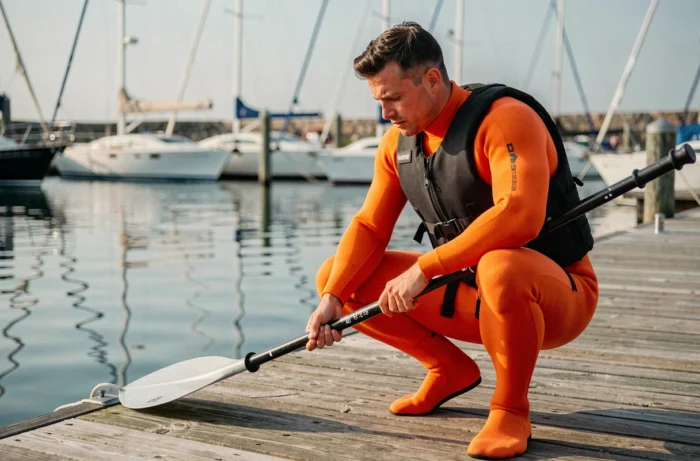
Going out on the water without the right equipment risks ruining a paddle session, a boat outing, or a day of water skiing. Water activities require gear that is suitable for both the aquatic environment and the French regulatory constraints, which have evolved in recent years. Here are the pieces of equipment that make a real difference between an enjoyable experience and a hassle on the water.
Standard NF EN ISO 12402: What the buoyancy level of the life jacket changes
Most lists of water sports equipment simply mention the life jacket. The point that deserves your attention is the buoyancy level suited to your weight and your navigation area. The NF EN ISO 12402 standard distinguishes several levels: 50, 100, and 150 newtons.
A level 50 jacket is suitable for calm waters close to shore. Level 100 is required as soon as you venture further out, and it is also the mandatory threshold for children weighing 30 kg or less, regardless of the navigation area. Level 150 pertains to offshore navigation.
Why does this distinction really matter? Because a level 50 jacket will not turn an unconscious person face up. Level 100 will. Choosing the right level means choosing between a comfort accessory and a true personal flotation device (PFD). Inspections are increasing along the French coast, and penalties specifically target the mismatch between the jacket worn and the navigation situation.
For those who engage in towed sports (tubing, wakeboarding, water skiing), there are now jackets that combine buoyancy and shock protection. This dual requirement has become a criterion in its own right, as it conditions both the legality and safety of the practice.
If you want to discover the H2O Sport website, you will find a range of jackets and accessories categorized by type of water activity, making it easier to choose the right level.
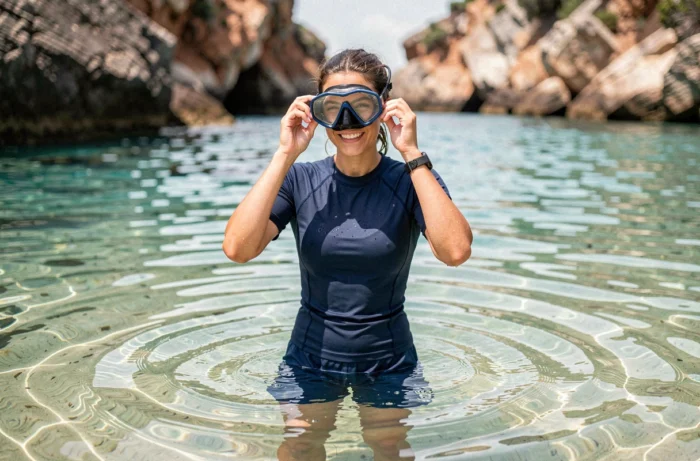
Wetsuit: thickness and cut according to the season
You may have noticed that after twenty minutes in water below twenty degrees, fatigue sets in much faster? The wetsuit is not only meant to avoid the cold. It limits energy loss and extends practice time.
The thickness of the neoprene is chosen based on the water temperature, not the air temperature. For a lake in summer, a short wetsuit (shorty) is sufficient. For paddleboarding or surfing in the Atlantic from autumn onwards, a full suit several millimeters thick becomes necessary.
The cut also plays a often underestimated role. A suit that is too loose allows water to circulate between the skin and the neoprene, negating the insulating effect. Conversely, a suit that is too tight limits movement and causes chafing. The ideal: try the suit with arms raised and squatting to ensure it doesn’t pull at the shoulders or knees.
Neoprene maintenance to extend its lifespan
Rinsing the wetsuit in fresh water after each use in salt water prevents degradation of the glued seams. Drying should be done in the shade, on a wide hanger. Neoprene exposed to direct sunlight loses its elasticity in a few weeks.
Marine VHF and kill switch: two often overlooked safety equipment
The kill switch, this small cord connected to the pilot’s wrist, is now mandatory on motorboats in France. Its role: to immediately cut the engine in case the pilot falls. Without it, a boat continues on its course at full power, posing a direct danger to people in the water.
The onboard VHF requires active monitoring on channel 16, the international distress channel. It is not just a comfort transmitter: as soon as a VHF is on board, its use becomes regulatory. In case of a problem, it is the most reliable means to contact rescue at sea, much more so than a mobile phone, whose coverage often stops a few kilometers from shore.
- The kill switch must be attached to the pilot’s wrist or jacket, never left hanging freely
- The VHF must be turned on and set to channel 16 throughout navigation
- Spare batteries or power sources for the VHF are part of the safety equipment to check before each outing
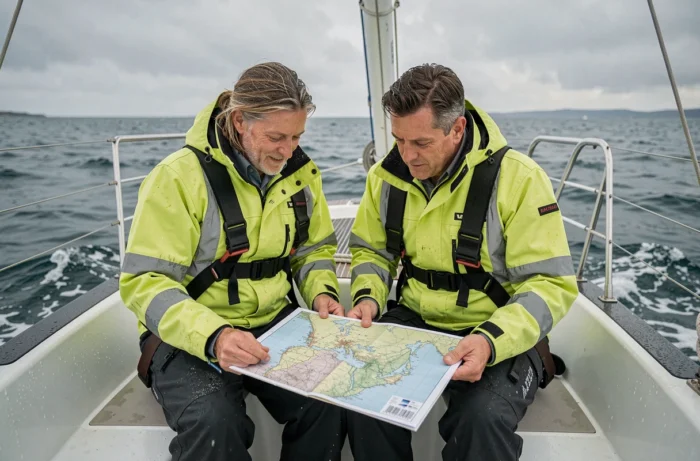
Paddle, kayak, boat: adapting your equipment to the type of water activity
A paddleboarder on a calm lake and a towed water skier at full speed do not have the same needs. The common base (jacket, sun protection, suitable shoes) remains the same, but the specific accessories change radically.
For paddleboarding and kayaking, the security leash connects the practitioner to the craft and prevents being separated from the board or kayak after a fall. At sea, this link is particularly critical when the wind pushes the craft faster than you can swim.
For towed sliding sports, the priority is on the impact vest (shock protection at the surface) and a quick release system. In case of a high-speed fall, being able to detach from the tow rope in a split second is part of the reflexes taught from the initiation stage.
The waterproof bag, a basic often forgotten
Phone, car keys, boat papers: everything that cannot withstand water must travel in a waterproof bag. This is not a gadget. A quality waterproof bag withstands complete immersion, not just splashes. Check the IPX certification of the bag before purchase.
- For paddleboarding or kayaking, a bag of five to ten liters is sufficient for personal items
- For a boat outing, a larger model also protects spare clothes and onboard electronics
- Models with a waist strap remain accessible even in case of capsizing
French regulations on water safety equipment have significantly evolved, transforming several accessories that were once merely recommended into legal obligations. Before each season, checking the condition of the equipment stored over the winter (jacket seams, waterproofing of the bag, flexibility of the neoprene) remains the most cost-effective action to fully enjoy your water activities without unpleasant surprises.