
The artistic size of a hedge is not limited to using a hedge trimmer twice a year. It involves a fine understanding of the physiology of each shrub, knowledge of growth responses to different cuts, and mastery of the technique that distinguishes plant shaping from simple maintenance. Here we address the technical points that make the difference between a sculpted hedge and a simply trimmed hedge.
Physiological response of shrubs to formative cuts
A formative cut does not produce the same effect depending on whether it is applied to new wood or old wood. On this year’s shoots, pruning stimulates the axillary buds located immediately below the cut point, which densifies the silhouette. On older wood, the response is less predictable: some species (yew, boxwood) easily regenerate dormant buds, while others (thuja, Leyland cypress) will never sprout again on bare wood.
It is this fundamental difference that determines the choice of species for topiary. Boxwood and yew remain the two reigning species of plant sculpture because they tolerate repeated cuts on old wood without becoming bare. Hornbeam and privet offer an interesting compromise for simple geometric shapes, but their looser leaf grain limits the detail’s fineness.
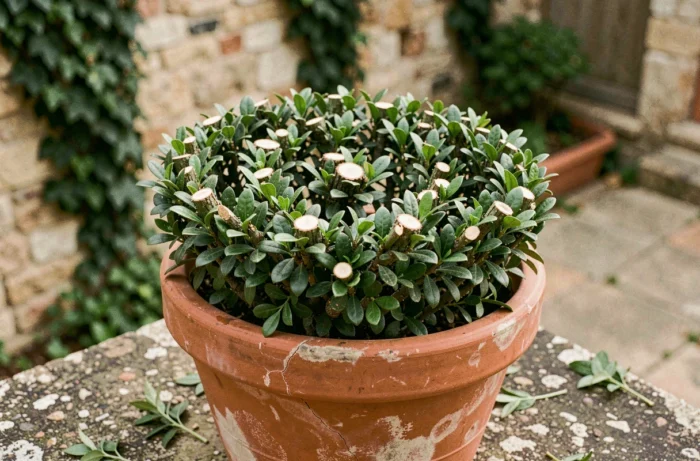
We recommend always pruning slightly back from the target shape. The regrowth will fill the gap in a few weeks in spring, and the surface will gain a more compact appearance than a flush cut to the template.
Resources dedicated to hedge sculpting, such as those available on sculpte-haie.com, detail the templates and cutting guides suitable for each species.
Trapezoidal profile and light management on sculpted hedges
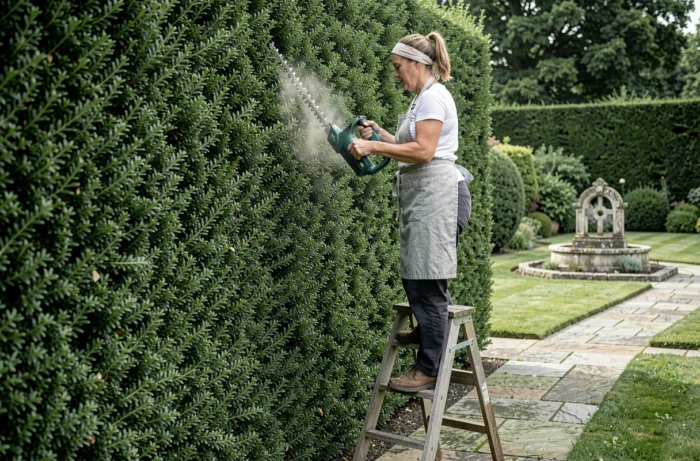
An artistic hedge that becomes bare at the base is a technical failure, not an aesthetic problem. Basal thinning almost always results from too vertical a profile: the upper branches shade the base, and the lower shoots eventually die due to lack of photosynthesis.
The solution is known but rarely applied rigorously: give the cross-section of the hedge a shape that is slightly wider at the bottom than at the top. For a two-meter hedge, we recommend a width difference of at least ten to fifteen centimeters between the base and the top. This trapezoidal profile ensures sufficient sunlight for all levels of vegetation.
For complex topiary shapes (spirals, tiered balls), the principle remains the same at the scale of each module: each level of the shape must receive enough direct light to maintain its leaf density. Neglecting this point leads to gaps in the sculpture after two or three seasons.
Pruning frequency according to the type of shape
Simple geometric shapes (parallelepiped, cone) tolerate two annual prunings, in spring and late summer. Complex shapes (animals, spirals) require three to four interventions per year to maintain sharp lines, especially on fast-growing species like privet or hornbeam.
- Boxwood in ball or cone: two passes are sufficient, one in May-June after the first growth and one in September before the vegetative rest.
- Yew in spiral or figurative shape: at least three passes, as irregular regrowth quickly distorts the edges.
- Hornbeam or privet in geometric hedge: two clean cuts, supplemented by a light pass with the hedge trimmer in July if growth is vigorous.
Unique hedge regime: recent regulatory constraint to know
Decree No. 2026-829 of August 28, 2026, established a unique hedge regime applicable throughout French territory. This text directly concerns artistic transformation projects when they involve the partial or total destruction of an existing hedge.
Since October 1, 2026, in mainland France, any hedge destruction requires a single declaration to the prefect. In the absence of a specific prefectural order, the fallback rule requires one meter of replanted hedge for every meter destroyed.
In practical terms, if a topiary project involves uprooting a section of a wild hedge to replace it with sculptable subjects (boxwood, yew), this operation potentially falls under the decree. We observe that many landscapers and individuals are still unaware of this obligation, which came into effect very recently.
Soil maintenance and nutrition to support repeated pruning
Frequent cuts mobilize the shrub’s reserves. Without appropriate nutritional input, regrowth weakens, foliage density decreases, and the sculpted shape deteriorates.
- Organic mulching (branch chippings, dead leaves) maintains moisture and gradually nourishes the soil through decomposition. We recommend a sufficient thickness to limit evaporation without suffocating the collar of the plants.
- A moderate nitrogen input in spring stimulates leaf growth, but an excess produces overly long internodes that blur the shape. Better to use a balanced fertilizer than a pure nitrogen boost.
- Targeted watering at the base, through drip or porous hose, avoids wetting the foliage and limits the development of fungal diseases, particularly on boxwood (sensitive to Cylindrocladium).
Nesting period and legal framework for pruning
The biodiversity law protects nesting birds. Pruning a hedge between March 15 and July 31 exposes one to sanctions if active nests are present. For artistic pruning, this requires planning major interventions for late summer or autumn, and limiting spring passes to light touch-ups after a visual inspection of the hedge.
This constraint is not trivial for complex shapes that require frequent interventions. A well-constructed pruning schedule incorporates the regulatory window from the project’s design, choosing species whose peak growth occurs outside the protected period.
The success of a sculpted hedge hinges on three simultaneous axes: the choice of species capable of regenerating on old wood, a cutting profile that preserves light at every level, and a schedule that respects both the physiology of the shrubs and legal obligations. Ignoring any of these three parameters will always be reflected in the hedge.