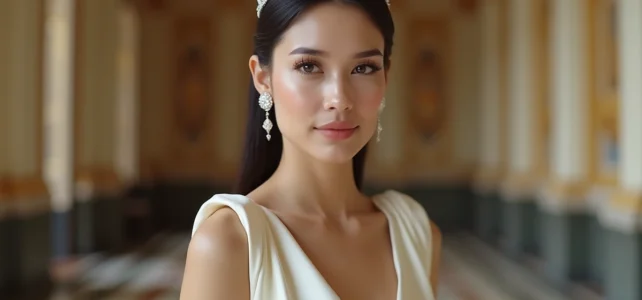
Tiaras and diadems are two terms used interchangeably in most conversations. Confusing them poses no problem in everyday life, but when it comes to choosing a headpiece for a wedding or ceremony, the distinction becomes useful. Shape, height, positioning on the head, occasions for wearing: several criteria separate these two headpieces, and comparing them point by point allows for a quick decision.
Tiaras and diadems compared: shape, structure, and positioning
The confusion between tiara and diadem arises from the fact that both are worn on the top of the head. However, their geometry and function differ distinctly.
| Criterion | Tiara | Diadem |
|---|---|---|
| General shape | Semi-circular, often tall and voluminous | Flatter band, sometimes in an open arc |
| Covered area | Covers a large part of the top of the head | Focuses on the frontal area |
| Height | Variable, can reach several centimeters above the hairline | Low profile, rarely very high |
| Attachment | Side combs or pins integrated into the hairstyle | Resting on the forehead or held by a thin headband |
| Common materials | Precious metals, diamonds, stones, pearls | Precious metals, crystals, pearls, rhinestones |
| Perceived weight | Heavier, rigid structure | Lighter, flexible or fine structure |
The key point to remember: the tiara is distinguished by its height and volume, while the diadem remains a discreet frontal ornament. A diadem can be slipped into a low bun without altering the hairstyle’s silhouette. A tiara, on the other hand, becomes the visual center of the head.
To delve deeper into the difference between tiara and diadem, one must also consider the historical context: the tiara has long been associated with sovereign power and official ceremonies, while the diadem served as a more personal ornament, worn at balls or private receptions.
Wearing protocol: who wears what and when
In British royal families, the tiara follows a rule documented by specialized media: only married women wear a tiara at official events. A single woman turns to a headband, a comb, or adorned pins. This convention dates back to the second half of the 19th century, after the discovery of diamond deposits in South Africa that fueled the production of tiaras for the Crown.
The diadem does not follow this strict protocol. It can be worn more freely, including by unmarried women, at festive events or religious ceremonies. This flexibility explains its popularity in civil weddings and less formal celebrations.
Occasions suited for each ornament
- The tiara is suitable for religious weddings with a voluminous princess-style gown, official galas, and events where the dress code mentions “white tie” or “formal attire”
- The diadem pairs well with more streamlined dresses (mermaid cut, minimalist gown), civil weddings, dressed-up evenings, or styled photo shoots
- In a red carpet context, both can appear, but the tiara signals an intention of majesty, while the diadem plays a role as a fashion accessory
The royal protocol has no binding value outside European courts. In a civil wedding, the choice depends on the style of the dress and hairstyle, not on a rule of etiquette.
Wedding trend 2024-2026: the rule of the unique statement piece
Recent wedding guides converge on a composition principle that changes how tiaras or diadems are worn: choose a single area of accent among the head, neck, and ears. Pairing an imposing tiara with a very prominent necklace is now seen as outdated in wedding fashion.
This rule has direct consequences on the choice between the two ornaments. A bride who wishes to wear a visible pearl necklace or pendant would do well to opt for a discreet diadem rather than a tall tiara. Conversely, a voluminous tiara stands on its own and is ideally worn with discreet earrings, without a necklace.
Adapting the ornament to the style of the dress
Hair and wedding accessory specialists have been recommending precise pairings for several seasons:
- Voluminous princess gown with a petticoat: tall tiara or ornate crown, which balances the volume of the lower silhouette
- Minimalist slip dress or straight cut: thin headband, ornate comb, or flat diadem, as a tiara creates a mismatch in style
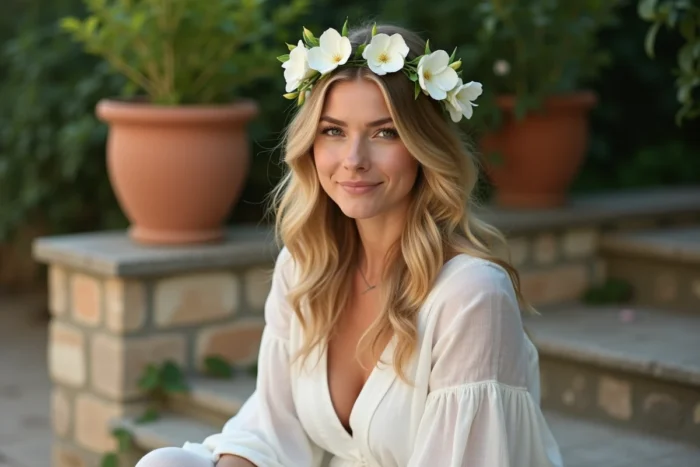
- Bohemian or country dress: floral pins or discreet comb, as both classic ornaments appear too formal
- Mermaid or sheath dress: low-profile diadem or jeweled headband, to extend the clean line without overload
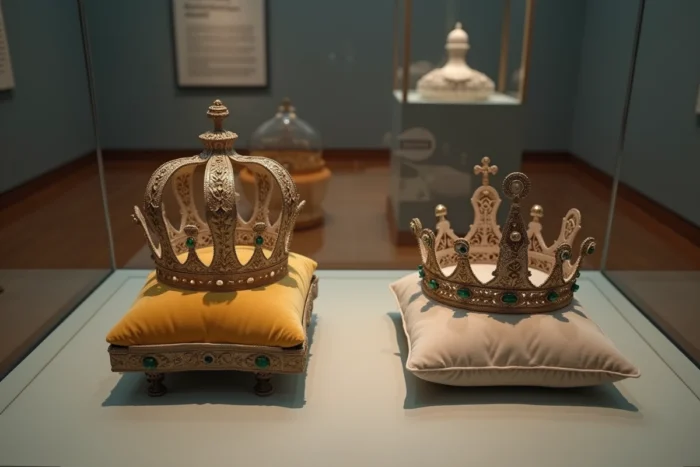
Hairstyle and attachment: technical constraints often overlooked
One aspect rarely addressed in comparisons between tiara and diadem concerns the hairstyle needed to support each piece. A tiara requires sufficient hair volume to anchor its side combs. Fine or very short hair complicates its hold without adding hairpieces or extra pins.
The diadem, being lighter and often mounted on a headband, attaches without restructuring the hairstyle. It can be placed on a bun, loose hair, or a half-ponytail without particular difficulty. For a bride planning to dance for several hours, this practical parameter weighs as much as aesthetics.
Consulting with the hairstylist before purchasing the accessory remains the most reliable approach. Testing the hold of the ornament during the hairstyle fitting avoids unpleasant surprises on the big day. A beautiful tiara that slips after an hour of wear loses all its appeal.
Ultimately, the choice between tiara and diadem rests on three concrete variables: the style of the dress, the type of planned hairstyle, and the desired area of accent. The tiara imposes its presence and requires an adapted hair arrangement. The diadem adapts to more varied contexts with fewer constraints. Neither is superior, but each responds to a specific style.