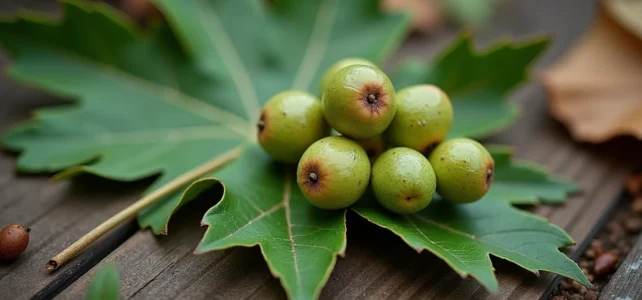
Oak galls, those rounded growths found on leaves or buds, regularly concern walkers and gardeners. The gall itself, caused by the laying of eggs by insects from the Cynipidae family, does not present any direct toxicity to humans. The real issue lies elsewhere: in the pollen environment of the oak and in the cross-reactions that this tree can trigger in sensitive individuals.
Oak gall and skin contact: what the literature does not report
Handling a gall, cutting it, or even crushing it with bare hands does not cause any documented burning or skin irritation. The plant tissues that make up the gall are produced by the oak itself in response to the injection of chemicals by the female cynipid at the time of laying eggs. These tannin-rich tissues do not contain stinging compounds comparable to those of a nettle or sumac.
An article detailing the danger of oak galls for humans confirms that the gall is not a vector of pathogens for humans. The larva that develops inside remains confined in its chamber and does not sting or bite.
Field reports diverge on one specific point: some people report itching after handling old galls that are open and colonized by secondary microorganisms (fungi, opportunistic mites). The fresh gall does not cause any known skin reaction. In contrast, a decaying gall may harbor mites whose droppings are allergenic, a mechanism distinct from the gall itself.

Pollen allergy from oak: the real risk surrounding the gall
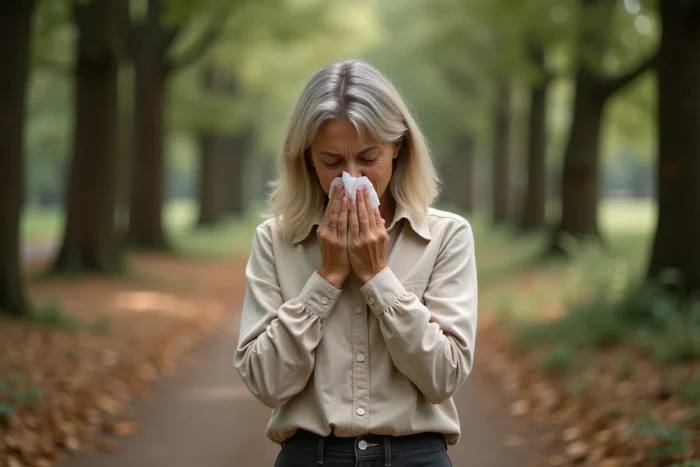
The confusion between galls and allergies is explained by a coincidence in timing. Galls appear in spring, a period when the oak releases its pollen massively. A walker who sneezes while picking up a gall attributes their symptoms to the growth while they are actually reacting to the pollen suspended in the air.
Recent pollen monitoring reports classify oak pollen with a moderate allergic risk, significantly increasing in spring in France. France Pollens notes a rising trend over recent seasons. This development, rarely associated with the topic of galls in online content, changes the perception of risk for people spending time under oaks infested with galls.
Why oak pollens are becoming more aggressive
Two factors amplify the allergenic power of oak pollens. Climate change extends the pollination period and increases the amount of grains emitted. Air pollution, particularly ozone peaks during the summer, weakens the grain envelopes and facilitates the release of allergenic proteins upon contact with mucous membranes.
Oak pollens are more aggressive than they were ten years ago, a finding shared by several regional air quality organizations. Allergy sufferers describe more pronounced and prolonged symptoms than before.
Cross-reactions and hidden allergens under oaks
Oak pollen belongs to the Fagaceae family and shares allergenic proteins with other trees such as birch, hornbeam, or hazel. A person allergic to birch may therefore react upon contact with an environment rich in oaks, including galls, without ever having been specifically diagnosed for oak.
- House dust mites share molecular allergens with certain arthropods present in open galls, which can provoke cross-reactions in individuals sensitive to domestic mites.
- Ticks, common in oak areas, pose a real health risk (Lyme disease) but are completely distinct from the gall phenomenon. The Grand Est Regional Health Agency reminds that tick vigilance is essential in oak undergrowth, galls or not.
- Fungi that colonize decaying galls release spores that can trigger rhinitis in individuals sensitive to mold, an allergen rarely suspected in this context.
The allergic risk under an oak is multifactorial: pollen, mites, fungal spores, and ticks coexist in the same environment. Attributing symptoms solely to the gall ignores the complexity of exposure.
Oak gall and children: should handling be prohibited?
Galls fascinate children, who collect, open, and gather them. The question of danger frequently arises among parents. From a toxicological standpoint, no accidental ingestion of a gall has been associated with poisoning. The tannins contained in the gall have a bitter taste that naturally discourages consumption.
A reasonable precaution is to avoid handling old, dry, and perforated galls, those that have been abandoned by the larva and may harbor mites or molds. Fresh, closed, and still green galls pose no problem to touch.
For children with diagnosed respiratory allergies, the real risk does not come from holding a gall but from prolonged exposure under the canopy of an oak during peak pollination. Taking an antihistamine beforehand and performing a nasal wash upon return remain the most effective measures.
Oak gall and phytosanitary regulations: a non-issue for human health
Oak galls are not subject to any health regulations aimed at protecting individuals in France. They fall under plant health, not public health. Phytosanitary services are only concerned with galls when they weaken exploited forest populations.
The United Kingdom has maintained an export ban on certain oak-related plants for forest biosecurity reasons, not to protect human health. No European health authority classifies oak galls as a danger to humans.
The available data do not allow for a conclusion regarding a link between the density of galls on an oak and the intensity of pollination. A heavily galled tree does not necessarily emit more pollen than a healthy tree. The massive presence of galls indicates a high pressure of Cynipidae insects, an ecological indicator, not a health alert signal for nearby residents.