
The development of a child relies on a set of skills that are acquired gradually: language, motor skills, emotional regulation, and attention capacity. Supporting this progression on a daily basis means adjusting interventions to what the child already knows how to do and what they are about to master. There is no universal recipe, but concrete mechanisms that educational research has documented for decades.
Parental Scaffolding: The Right Level of Help at the Right Time
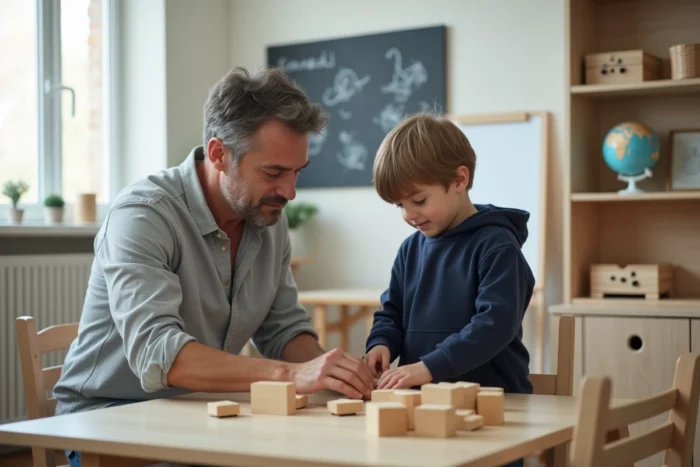
Scaffolding refers to the temporary support that an adult provides to a child to help them accomplish a task they cannot yet do independently. The principle is simple: intervene just enough for the child to progress without doing it for them. A child learning to tie their shoes needs to be shown the action, have their fingers guided, and then be allowed to try on their own.
In practice, this means observing before acting. When a child struggles with a puzzle, the temptation is to place the piece for them. A more effective approach is to draw their attention to a detail (the color of the edge, the shape of the notch) so that they can find the solution themselves.
Several online resources detail these strategies according to age groups. Parents looking for appropriate benchmarks can consult the E-woman site for children, which addresses these issues from various practical angles.
Scaffolding also works for social learning. When a three-year-old does not yet know how to ask a peer for a toy, phrasing the sentence for them the first time and then encouraging them to repeat it constitutes effective verbal scaffolding. The gradual withdrawal of help is key: as soon as the child succeeds on their own, the adult steps back.
Oral Language and Reading Activities Before Age Six
The new kindergarten program applicable from the start of the 2025 school year reinforces the priority given to oral and written language as well as early mathematical tools, with a more structured progression throughout the entire cycle 1 (small, medium, and large sections). This overhaul has a direct impact on what parents can do at home to support school learning.
Shared reading remains the most accessible activity. Reading an album aloud is not just about turning pages. Asking open-ended questions about the story (“Why do you think the character is sad?”) engages comprehension, vocabulary, and the ability to formulate a complete idea.
Books and Language Games in Daily Life
Nursery rhymes, rhyming games, and riddles work on phonological awareness, a skill directly linked to future reading learning. Naming everyday objects precisely (saying “ladle” instead of “thing for soup”) enriches vocabulary effortlessly.
- Read at least one album per day, varying genres (documentary, tale, picture book) to diversify vocabulary
- Rephrase the child’s sentences by completing them rather than correcting them outright (“Do you mean that the cat jumped on the table?”)
- Incorporate categorization games into daily life: sort groceries by color, group clothes by type, name geometric shapes on the street
A child who hears complex sentences produces them more quickly themselves. Daily language immersion, even informal, has more effect than isolated formal exercises.
Screen Management and Attention Capacity in Children
Screens are part of family life. Rather than focusing on an ideal number of hours, the relevant question is what the screen is replacing. An hour of cartoons that replaces an hour of free outdoor play does not have the same effect as an hour of educational video that replaces a car ride.
Passivity in front of the screen is the central problem, not the screen itself. A child watching a video without interaction misses an opportunity to manipulate, explore, and ask questions. Interactive content, used with an adult who comments and questions, limits this passive effect.
Alternative Activities to Develop Concentration
Attention capacity is built through activities that require sustained effort over an increasing duration. Building a tower of blocks, following a simple recipe, observing insects in the garden: these situations require the child to maintain focus without artificial stimulation.
- Offer hands-on activities with a visible goal (a collage to finish, a construction to complete) rather than open-ended activities without a defined end
- Limit interruptions during independent play: a child focused on a drawing does not need to be offered something else
- Alternate physical activities and calm activities to regulate the level of excitement throughout the day

Educational Framework and Emotional Regulation in Children
Setting a framework does not mean multiplying prohibitions. An effective educational framework relies on a few stable rules, stated positively (“We walk in the house” rather than “Don’t run”), and applied consistently between both parents.
Emotional regulation is not taught through instructions. It is transmitted by example and by support during a crisis. Naming the emotion the child is feeling helps them recognize it and, gradually, manage it on their own. Saying “You are angry because your brother took your toy” gives a word to a still-confusing sensation.
Children’s tantrums between the ages of two and five often stem from a gap between what they want and what they know how to express. Increasing their emotional vocabulary (frustrated, disappointed, impatient) mechanically reduces the frequency of outbursts, as the child has a tool other than screaming to make themselves understood.
Protection of Children During Extracurricular Times
A recent bill on child protection introduces a prefectural control regime for certain youth services that have previously been poorly regulated, particularly extracurricular services. This text also requires informing parents of the identity of all individuals interacting with their child in this context. These provisions enhance transparency for families who entrust their children to structures after school.
Everyday education does not play out in a single register. Language, attention, emotions, framework: these dimensions feed into each other. A child who has the words to express their emotions concentrates better. A child who benefits from a stable framework dares to explore more. Every micro-adjustment by parents, repeated day after day, builds the foundations for lasting autonomy.