After the death of a spouse, the wedding ring often remains on the finger for weeks, months, sometimes years. This piece of jewelry worn daily holds an emotional weight that few other objects possess. The question of how to wear the ring of a deceased husband does not arise the day after the funeral; it emerges later, when daily life resumes and the gaze of others changes.
The symbolic weight of the wedding ring in marital mourning
The wedding ring is not an ordinary piece of jewelry. It was chosen together, worn every day, associated with a specific commitment. When one of the two disappears, the ring does not lose this weight; it concentrates it.
What makes the situation complex is that the ring carries both the past and the present of widowhood. It tells others “I am married” even though the civil status has changed. This discrepancy between the visible symbol and the administrative reality creates discomfort that each widow manages differently.
Some continue to wear it on the left ring finger without questioning it. Others feel the need to change something, not to forget, but to have the jewelry better reflect their situation. There are no religious, civil, or social rules that impose a specific behavior. The choice to wear the ring of a deceased husband remains entirely personal, and it can evolve over time.
Changing fingers or hands: what it means in different countries
The most common gesture is to move the ring from the left hand to the right hand. In France, the ring is traditionally worn on the left ring finger. Moving it to the right marks a transition without a break: the jewelry remains visible, but its position signals a change in status.
This practice varies across cultures. In several Northern and Eastern European countries, the wedding ring is already worn on the right hand. Therefore, the gesture of “changing hands” does not have the same symbolic significance everywhere.
The choice of finger is as important as that of the hand. Some widows wear the ring on the little finger or the middle finger to clearly distinguish it from an “active” wedding ring. Others stack both rings (their own and the deceased’s) on the same finger, a gesture that frequently appears in the testimonies of widows and widowers.
Wearing both rings together
Stacking both rings on the same ring finger is a deliberate choice. It expresses the continuity of the bond and the desire to keep both stories together. This double wear sometimes poses a practical size issue: the rings do not have the same diameter, and one may hinder the other.
Having the deceased spouse’s ring adjusted by a jeweler solves the problem. Some artisans also offer to fuse the two rings into one, an option that appeals to those who want a unified piece of jewelry.
Transforming the ring into another piece of jewelry: pendant, ring, bracelet
Transforming the ring into a pendant is the most common alternative. The ring slipped onto a chain is worn close to the heart, remains discreet under clothing, and does not raise the question of finger or hand. For many grieving individuals, this solution offers a compromise between closeness and discretion.
Other transformations exist:
- Melting down both rings to create a unique ring with a new design, incorporating the gold from both rings into a single piece of jewelry
- Integrating the ring into a rigid bracelet, which completely changes the nature of the jewelry while preserving the original metal
- Entrusting the ring to a jeweler to make it into a pendant set with a stone, combining memory and aesthetic renewal
The transformation does not erase the symbolism; it shifts it. The metal remains the same, the story remains inscribed in the material. What changes is how one chooses to display it or keep it for oneself.
Ring and reconstruction: when jewelry hinders or supports mourning
Professionals in grief support observe that the relationship with the jewelry evolves in phases. In the first months, removing the ring may seem unthinkable. Later, continuing to wear it can become a source of inner tension, especially when a new relationship begins to form.
There is no timeline. Some people remove the ring after a few months, others after several years. A few never take it off. No timeframe defines a “normal” or “completed” mourning, and the decision regarding the ring should not be dictated by those around.
What emerges in the testimonies is the importance of the chosen moment. Removing the ring under social pressure (family, new partner, colleagues) often generates regret. Doing it when one feels ready, even if it takes years, fits into a more peaceful mourning process.
The question of passing it down in the family
Passing the ring to a child or grandchild represents another avenue. This gesture places the jewelry within a family lineage and gives it a new function. The ring transitions from being a marital symbol to an inheritance.
This transmission can be done directly (giving the ring as is) or after transformation. Some parents have a date or a word engraved inside the ring before passing it on, so that the child carries both the memory of the couple and a personal message.
- Transmitting the ring during a family event (child’s wedding, birth) gives the gesture strong symbolic significance
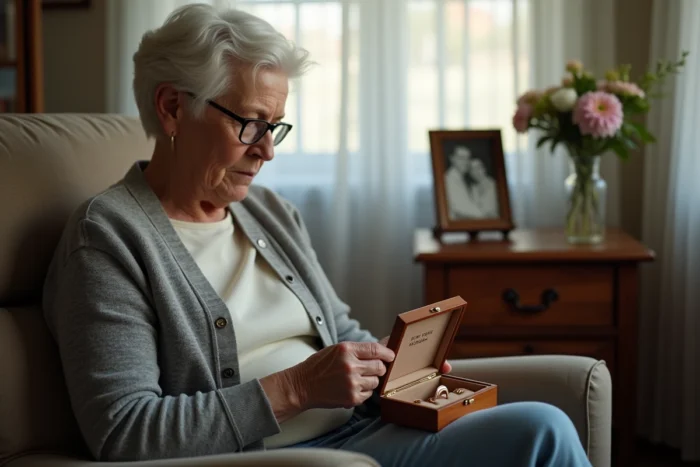
- Keeping the ring in a dedicated box, along with a letter or a photo, creates a more complete memory object than the jewelry alone
- Having several small pieces of jewelry made from a single ring allows sharing the memory among several family members
The place of the ring after widowhood is not limited to a protocol. It is an intimate choice that evolves over time, emotions, and stages of reconstruction. The jewelry remains, in whatever form, a tangible link to a shared story. The only rule that matters is the one you set for yourself.