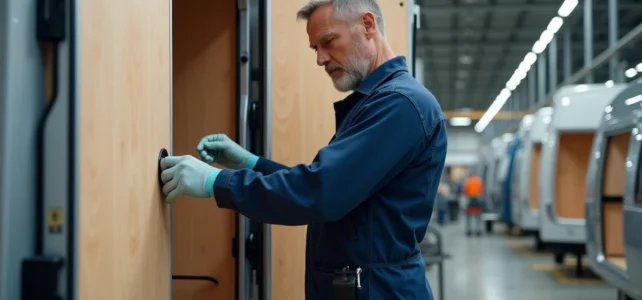
On camping grounds in the south of France, you regularly come across caravans bearing the name Rubis. Polyester body, compact lines, meticulous finishes: these models intrigue because there is neither an official brand website nor traditional industrial communication. The question “who manufactures the Rubis caravan” appears in all caravan forums, and the answer deserves some clarification of a few persistent confusions.
Rubis Caravan: an artisanal brand without an industrial showcase
When searching for “Rubis” online, the first results lead to Rubis, the publicly traded group specializing in energy distribution (gas, oil). No relation to caravanning. This homonymy muddles the waters and fuels confusion.
Rubis is not a large industrial leisure group. Unlike manufacturers like Knaus Tabbert, which is publicly traded and has several factories in Europe, the Rubis brand operates on an artisanal model. There is no publicly documented factory registry or institutional page dedicated to production. To learn everything about the Rubis caravan, one must primarily cross-reference information from dealers and communities of enthusiasts.
This short-circuit operation, without mass communication, explains why the brand remains discreet. Rubis caravans are distributed through a network of exclusive dealers, including Fabre Caravanes in the Southwest (Carcassonne, Toulouse, Tarn, Ariège), which positions itself as the main point of sale.
Rubis Distribution Network: exclusive dealer rather than online catalog
The business model of Rubis contrasts with that of large European manufacturers. No online configurator, no downloadable catalog on a corporate site. You buy a Rubis by visiting a dealer and discussing options on-site.
Fabre Caravanes exemplifies this operation. This dealer offers the complete range, from compact models to the most spacious versions. The relationship is direct, almost custom-made.
This limited distribution has concrete consequences for the buyer:
- The geographical coverage remains limited, complicating access to after-sales service if you live far from the Southwest or the areas covered by the few dealers
- Delivery times and availability of parts heavily depend on the dealer, with no centralized tracking platform
- Resale on the second-hand market can be surprising: you can find listings in Poland or elsewhere in Europe, proof that these caravans circulate well beyond their initial sales area
The absence of an official manufacturer website is not a quality defect, but it requires going through the physical network to obtain reliable information about warranties and technical specifications.
Polyester construction and equipment: what distinguishes a Rubis caravan in the field
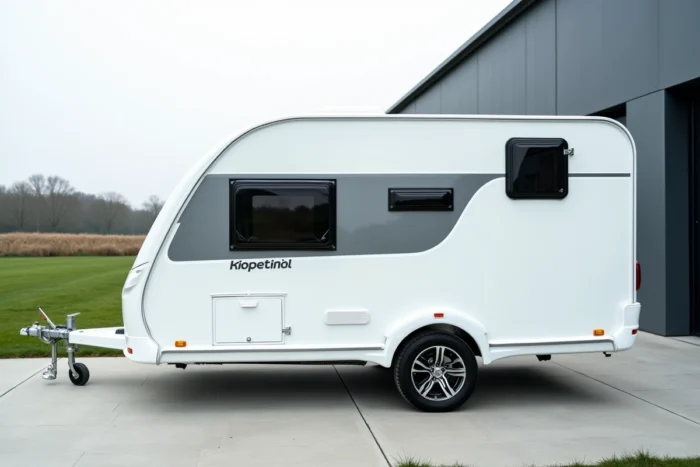
When inspecting a Rubis up close, the first thing that strikes you is the bodywork. Roof and walls made of polyester, where many manufacturers still use aluminum or traditional sandwich construction. Polyester offers better shock resistance and eliminates infiltration problems related to joints between panels.
The choice of all-polyester is a rare technical stance in this price range. In practice, this translates to simplified maintenance: no risk of delamination, easier cleaning, and better durability against UV rays and weather conditions.
Standard equipment on recent models
Recent collections (notably the 495 M model) include equipment that positions Rubis above the entry-level:
- Gas heating and water heater, integrated shower with enough space to be genuinely usable
- SNCF blinds and mosquito nets on all windows, slatted bed base, white aluminum rims
- Transition to all-electric on some recent models, which eliminates some of the constraints related to gas during prolonged parking
Feedback varies on this point, but several users highlight that the interior layout resembles a small studio rather than a traditional caravan, with space optimization prioritizing everyday livability.
Second-hand market and Rubis reputation among caravanners
An interesting indicator of the health of an artisanal brand is the dynamics of its second-hand market. Rubis caravans are regularly found for sale on specialized platforms, including abroad. In Facebook groups dedicated to caravan and camping fans, the question “why do we see so many Rubis for sale” periodically arises.
Several explanations circulate within the community. The volume of resale does not necessarily indicate a defect. It also reflects the natural renewal of an aging fleet and the gradual upgrading of recent models, which encourages some owners to upgrade.
The resale value remains stable for models in good condition, which is a positive signal. An artisanal caravan without a communication network manages to maintain its value in the secondary market thanks to the perceived quality of its construction.
Frequent confusion with other brands
The name “Rubis” being generic, it is sometimes confused with sub-ranges from other manufacturers or with unrelated models. Before buying second-hand, checking that the caravan indeed bears the Rubis characteristics (full polyester body, typical layout) helps avoid unpleasant surprises.
The Rubis caravan remains a unique object in the landscape of French caravanning. Artisanal manufacturing, confidential distribution, polyester construction: this positioning attracts an audience looking for something different from the standardized catalogs of large European groups. For those willing to go through the dealer network and forgo the comfort of a digitized after-sales service, it is a viable long-term option.