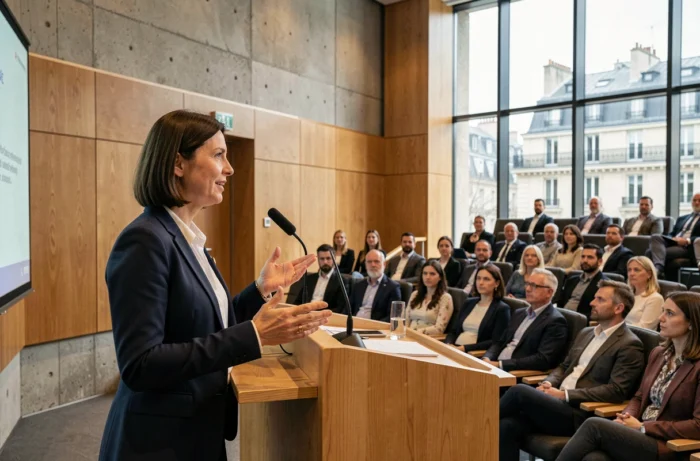
We’ve all attended an online training where, after the first fifteen minutes, attention drifts to another tab. The problem isn’t the content: it’s the lack of friction, unpredictability, and eye contact with someone who thinks differently. Conferences in Paris reintroduce this friction, and that’s precisely what makes them valuable for professionals and businesses.
Conference in Paris and informal learning: what the screen doesn’t convey
During an in-person seminar, the most productive exchanges don’t happen during the presentations. They occur during coffee breaks, in the hallway, or while exiting the venue. A participant asks a practical question to a speaker, two professionals in the same field compare their methods at a corner table.
This informal learning is hard to replicate remotely. Chat features or breakout rooms try to compensate, but the spontaneity of physical exchanges remains irreplaceable. In person, we also pick up on body language, hesitations, and side comments that add nuance to a statement. It’s this layer of non-verbal information that transforms simple listening into a true field experience.
The audience of clubformationdigital.fr in Paris illustrates this phenomenon well: participants come as much for the program as for the network built alongside the sessions.
Networking among participants and professionals: the real leverage of in-person events
An online training delivers knowledge. A conference in Paris delivers knowledge and contacts. The difference is not trivial: in many fields, exchanging a business card at the right moment is worth more than a complete e-learning module.

Paris concentrates a dense pool of professionals, experts, and decision-makers. In 2025, the city regained the second place in the ICCA ranking of congress cities, with a record of 1,200 in-person congresses. This is no coincidence: organizations reserve physical meetings for strategic exchanges and high-value decisions.
Networking at conferences works because it relies on a shared context. When two people attend the same presentation, they have an immediate conversation topic. This common starting point creates a more natural connection than a cold LinkedIn message.
What the hybrid format only partially resolves
Hybrid events (simultaneous in-person and remote) have multiplied. The format has its advantages for expanding the audience. Feedback on this point varies, but it is often observed that remote participants feel more like spectators than active participants. They access the content without accessing the network.
For teams looking for team building or corporate seminars, in-person events in Paris remain the format that generates the most actionable interactions after the event.
Conference venues in Paris: how the setting changes message reception
The effect of the venue on attention quality is often underestimated. A well-chosen conference room in Paris (natural light, well-designed acoustics, modular configuration) alters participants’ posture. One does not listen the same way in an amphitheater in Le Marais as in front of a laptop screen placed on a kitchen table.
Paris offers a diversity of professional venues that few cities in France can match:
- Contemporary event spaces in business districts, equipped for plenary or workshop formats
- Heritage venues (private mansions, historic salons) that add a memorable dimension to the experience
- Third places and incubators suitable for more informal formats, with circle or small group configurations
The choice of venue is part of the message. A company inviting its employees or clients to a well-appointed setting signals that it values this meeting moment. This signal does not exist in a video conference.

Online training and conference in Paris: complementarity rather than replacement
Opposing the two formats doesn’t make much sense in practice. Online training excels at conveying standardized technical knowledge, at one’s own pace, without geographical constraints. An in-person conference in Paris excels at everything the screen cannot simulate: debate, confrontation of experiences, and collective decision-making.
Organizations that make the most of their training budgets combine both. The theoretical content is delivered digitally. Practical application moments, feedback sessions, and networking take place in person.
- Digital prepares: modules beforehand so that participants arrive with a common foundation
- The conference activates: workshops, practical cases, direct exchanges with speakers
- Digital extends: replays, additional resources, online community post-event
This balance between digital and in-person increases retention and gives participants a concrete reason to travel. One does not make the journey to the venue to passively listen to what could have been read at home.
The accessibility of Paris, a real logistical advantage
Paris’s position in the French and European rail and air network facilitates participant attendance. For a corporate seminar that brings together teams from several regions of France, the capital remains the simplest convergence point to organize. This logistical aspect weighs in the choice of venue as much as the program itself.
Trade shows in the Île-de-France region have indeed seen attendance return to pre-health crisis levels, with growth in the number of exhibitors and occupied space. Professionals vote with their feet: when the event justifies the trip, they will travel.