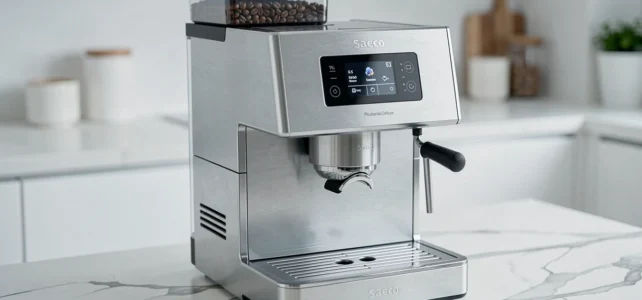
When looking for a coffee machine that can produce a decent cappuccino without spending ten minutes adjusting every setting, the Saeco Picobaristo Deluxe often comes up in discussions. Designed by Saeco (Philips group), this automatic machine targets households that want to vary their milk-based drinks daily without sacrificing the quality of espresso.
We took a close look at what this Deluxe model actually brings compared to the rest of the Picobaristo range, and where it shows its limits.
12-step grinder: what it changes in the cup
The Deluxe version (SM5570/SM5573) features a ceramic grinder with 12 grind settings, compared to 10 on the standard Picobaristo models. In practice, these two additional settings provide finer adjustments in the medium range, which is the most commonly used for short espressos and lungos.
The ceramic grinder has the advantage of being quieter than a steel grinder and heating the beans less during grinding. For family use (three to five coffees per day), the difference in noise is noticeable, especially early in the morning.
You can discover the Saeco Picobaristo Deluxe in detail to compare the SM5570/10 and SM5573/10 variants, which mainly differ in exterior finish and the exact number of programmed drinks.
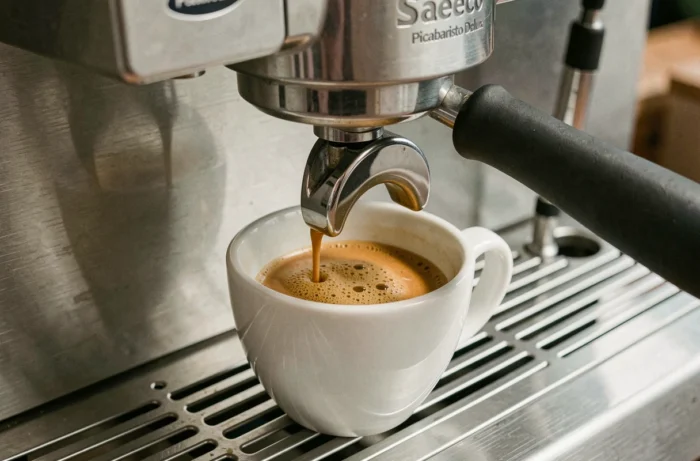
Milk jug and milk-based drinks on the Picobaristo Deluxe
The milk jug provided with the Deluxe stands out for a detail often overlooked: it can be stored directly in the refrigerator between uses. On competing machines in this price range, you often have to detach a tube, rinse it, and then reconnect it. Here, you simply remove the jug and place it in the fridge, which reduces daily handling.
Quality of foam for cappuccino and latte macchiato
The foam produced is dense and consistent for cappuccinos. For latte macchiatos, the texture remains acceptable, but feedback varies on this point depending on the milk temperature and type used (whole milk froths significantly better than semi-skimmed).
The SM5573/10 model offers access to 13 drinks at the touch of a button, including espresso, ristretto, doppio, lungo, americano, cappuccino, latte macchiato, espresso macchiato, café crema, café au lait, mix, frothed milk, and hot water. It has one of the widest catalogs available on an automatic machine in this segment.
Four user profiles: useful or gimmick
The Deluxe can memorize up to four profiles. Each user saves their preferences: strength, volume, amount of foam, temperature, and pre-infusion. In a household of two or three people, this is a real time-saver. You select your profile and press once.
For solo use, the profile function is less relevant. The LED touch screen of the Deluxe remains readable and responsive, but the interface requires some adjustment time. Several tests note that navigating the menus can seem complex in the first few days. Once the settings are memorized, you hardly return to them.
Concrete customization of drinks
Five aroma intensity levels are available. You can also adjust the water volume for each drink, the temperature, and the pre-infusion. The latter setting improves extraction on lightly roasted specialty coffees by moistening the grounds before full pressure.
- Aroma intensity: five levels, from lightest to strongest, adjustable by profile
- Cup volume: adjustable drink by drink, from tight ristretto to generous lungo
- Pre-infusion: useful for light roasts that require a longer contact time
- Temperature: several levels, handy for those who find their espresso too hot or not hot enough
Maintenance and AquaClean filter: what to watch for
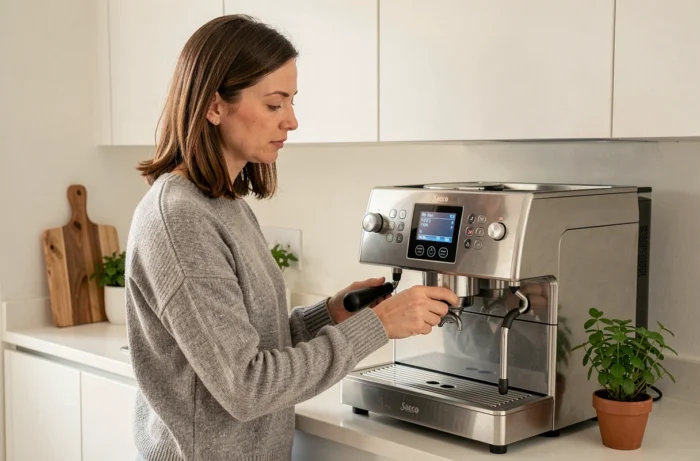
The coffee group is removable, making weekly rinsing easy. You take it out, rinse it under water, and put it back. This is not the case with all automatic machines (some Jura models, for example, have a fixed group).
The AquaClean filter reduces the frequency of descaling. Saeco claims a high number of cycles before needing to descale, provided the filter is replaced regularly. Without the AquaClean filter, limescale accumulates faster and descaling cycles become more frequent, especially in hard water areas.
Long-term robustness
Recent tests indicate that the Picobaristo platform shows signs of wear with intensive family use (more than five coffees per day for several years). Feedback from the early years was generally more enthusiastic about durability. If the machine is intended for a high-consumption household, this aspect deserves attention.
- Removable coffee group: quick rinsing without tools, to be done weekly
- AquaClean filter: to be replaced according to the manufacturer’s recommendations to space out descaling
- Used coffee grounds container: adequate capacity, to be emptied every two or three days under normal use
Pricing position of the Saeco Picobaristo Deluxe against competing machines
The Picobaristo Deluxe is positioned in the mid-high segment of automatic machines with grinders. It costs significantly less than the Saeco Xelsis, which remains the brand’s high-end model, while sharing some of its technology (ceramic grinder, milk jug, multiple profiles).
Compared to entry-level Delonghi Magnifica or Melitta machines, the Deluxe justifies itself with its drink catalog and customization options. For someone who only drinks black espresso, a simpler machine will suffice. The Deluxe makes sense when alternating cappuccinos, latte macchiatos, and long coffees in the same day.
The compactness of the machine makes it suitable for a standard kitchen. It takes up no more space than a large filter coffee maker, which is significant for an automatic with an integrated milk jug.